
A name such as 203×133×25 UB tells you which section is being discussed. It does not tell you how far that beam can span in your building. Use the chart on this page to identify dimensions, estimate bare-steel mass and understand the inputs behind our calculators.
The table contains 15 selected Universal Beam sections. It is generated from the same data as the calculators, so a section’s mass and stiffness remain consistent across the site. For the full manufacturer catalogue, including sections outside our selection, use the British Steel UB datasheet, pages 1 and 2 of the PDF.
Start with the complete designation
In 203×133×25, the first two numbers describe the nominal section depth and flange width in millimetres. The last number describes nominal mass in kilograms per metre. The letters UB identify the product family. None of these numbers is a steel grade, cutting length or load rating.
The actual dimensions can differ from the name. Our selected 203×133×25 has a listed depth of 203.2 mm, flange width of 133.2 mm and mass of 25.1 kg/m. A quotation that says only “203 beam” leaves out information needed to identify the product.
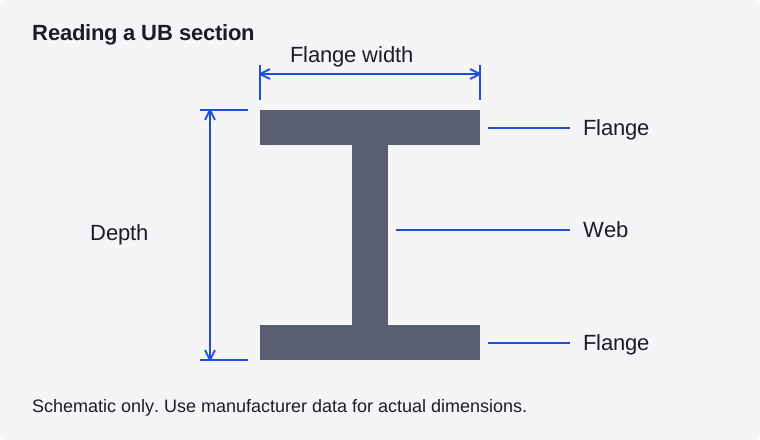
The flanges are the broad parts at the top and bottom; the web joins them. A heavier member in the same nominal family can have thicker material and different actual dimensions. Leave room in a design discussion for the connection, fire protection and finishes as well as the bare steel.
Choose the column that answers your question
| Your question | Relevant information | What that information cannot establish |
|---|---|---|
| Will the specified steel fit? | Actual depth and flange width | Clearance for plates, protection and installation |
| What is its theoretical mass? | Listed kg/m and full cutting length | Complete fabricated weight |
| How does it bend in the calculator? | Major-axis second moment of area, Iₓ | Strength, stability or support adequacy |
| What do I order? | Full designation, grade and issued fabrication detail | A design inferred from a nearby table row |
Iₓ describes how the section’s area is distributed about its major bending axis. Our elementary deflection model uses that value. A large Iₓ can reduce calculated deflection under otherwise identical assumptions; it does not remove the need for resistance and stability checks. The calculation method explains the distinction and the unit conversion from cm⁴ to mm⁴.
Work through a purchase-list example
Suppose an issued schedule calls for two pieces of 203×133×25, each cut to 4.3 m. The theoretical mass of one piece is 25.1 × 4.3 = 107.93 kg. For both pieces, it is 215.86 kg. Record the section and length next to the result so the total can be checked later.
That calculation excludes plates, brackets, bolts and finishes. It also uses ordered length, not the clear width of the opening. Ask the fabricator for the complete fabricated weight for delivery and lifting planning. A calculated mass is not a manual-handling instruction.
If the quotation instead names 203×133×30, stop and resolve the substitution. The extra mass changes the order weight, and the geometry is different. A supplier’s stock availability is not approval to alter the engineer’s specification.
Keep the three lengths separate
A measured clear opening, the span in an analysis and the steel cutting length answer different questions. The analysis may use support-centre distance; the issued bearing or connection detail determines the cutting length. Do not add an assumed allowance to the chart and use it as a fabrication instruction.
For a quotation enquiry, include the beam reference from the drawing, complete designation, grade, quantity, cutting length, holes and plates, finish and revision number. Ask whether delivery includes unloading and whether the proposed access route can accept the fabricated item.
Correction to earlier values
Earlier versions of this site mixed the major-axis inertia of 203×133×25 and 203×133×30. The corrected figures are 2340 cm⁴ and 2896 cm⁴, respectively. Generic safe-span and safe-load recommendations were also removed. Anyone who retained an earlier table for a project should check it against the current manufacturer data and their engineer’s design.
Use the weight calculator for order arithmetic and the section comparison tool for the stated elastic model. Structural work must be designed by a chartered structural engineer and receive the applicable Building Control approval. This article has not received an independent engineering review.
Manufacturer section table
| Designation | Mass kg/m | Actual depth mm | Actual width mm | Iₓ cm⁴ |
|---|---|---|---|---|
| 152x89x16 | 16 | 152.4 | 88.7 | 834 |
| 178x102x19 | 19 | 177.8 | 101.2 | 1356 |
| 203x102x23 | 23.1 | 203.2 | 101.8 | 2105 |
| 203x133x25 | 25.1 | 203.2 | 133.2 | 2340 |
| 203x133x30 | 30 | 206.8 | 133.9 | 2896 |
| 254x102x25 | 25.2 | 257.2 | 101.9 | 3415 |
| 254x146x31 | 31.1 | 251.4 | 146.1 | 4413 |
| 254x146x37 | 37 | 256 | 146.4 | 5537 |
| 305x127x37 | 37 | 304.4 | 123.4 | 7171 |
| 305x165x40 | 40.3 | 303.4 | 165 | 8503 |
| 305x165x46 | 46.1 | 306.6 | 165.7 | 9899 |
| 356x171x45 | 45 | 351.4 | 171.1 | 12195 |
| 356x171x51 | 51 | 355 | 171.5 | 14265 |
| 406x178x54 | 54.1 | 402.6 | 177.7 | 18893 |
| 457x191x67 | 67.1 | 453.4 | 189.9 | 29597 |
Source: British Steel, Universal Beams datasheet, 21 July 2026, pages 1 and 3. Transcribed 10 October 2026. Values describe the listed modern UB sections, not unidentified historic RSJs. The calculators and this table share the same data.